

By Stacey Weister, CRRC Senior Technical Manager
Interest in Passive Daytime Radiative Cooling (PDRC) technologies is growing, and the Cool Roof Rating Council (CRRC) is exploring how to evaluate these innovative products within the CRRC Product Rating Programs framework.
Unlike traditional cool roofing products, which rely on high Solar Reflectance (SR) and broad Thermal Emittance (TE) to reduce heat gain, PDRC materials are designed to selectively emit heat through the atmosphere’s “sky window” (the infrared wavelength range between approximately 8 and 13 micrometers, which allows thermal radiation to escape into outer space). By leveraging this phenomenon, PDRC products can potentially cool surfaces below ambient air temperature, even in direct sunlight. Many PDRC products also target ultra-high SR values exceeding 0.92.
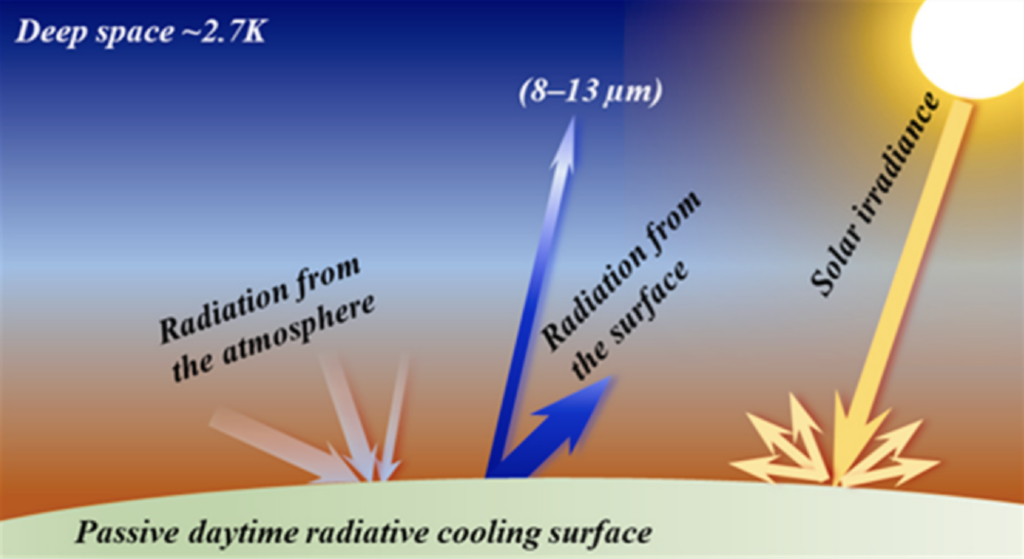
Image Credit: Ablimit Aili, et al., used under a Creative Commons license
These unique properties pose a challenge for existing CRRC rating methods. Current procedures determine TE by averaging emissions across the entire thermal infrared spectrum. Because PDRC products concentrate their emissions within the sky window, standard testing methods may classify them as having only “medium” emittance, thereby failing to capture their sub-ambient cooling capability.
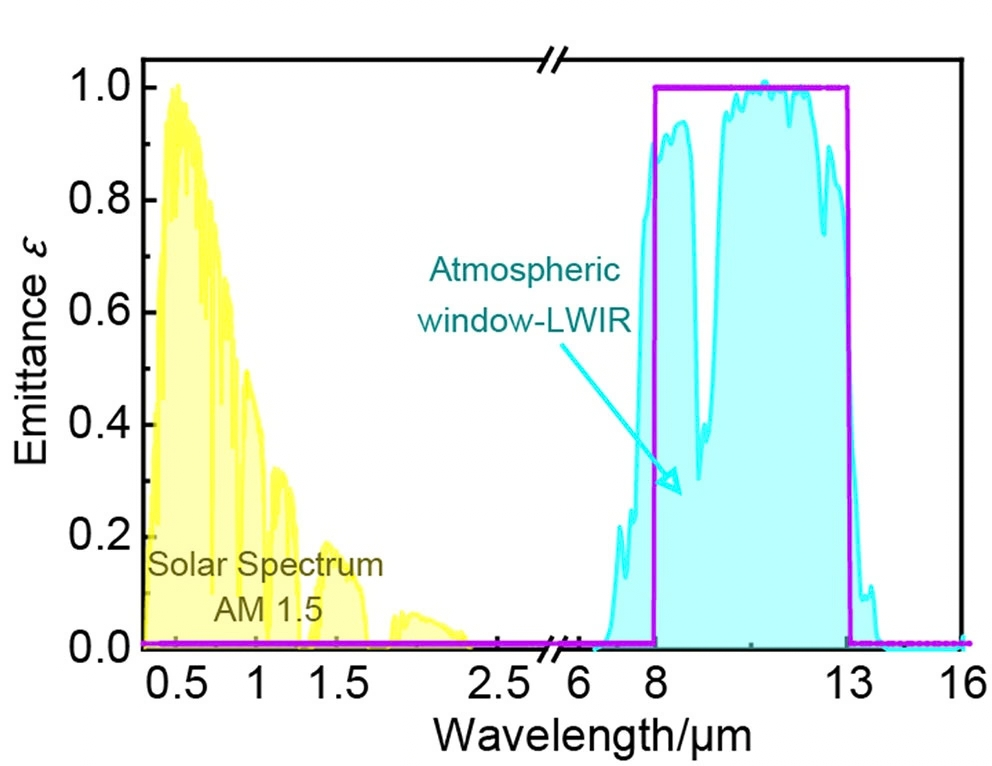
Image Credit: Meijie Chen, et al., used under a Creative Commons license
To address this issue, a PDRC Working Group (WG) was formed in March 2026. The group comprises industry professionals, national laboratories, academic researchers, and nonprofit organizations. Since its formation, members have met monthly and will continue to do so while reporting to the CRRC Technical Committee (Committee).
The WG has reached consensus that spectral radiative properties provide the critical baseline data needed to evaluate PDRC products. These include SR across the solar spectrum and TE across the full 4–80 µm thermal infrared spectrum. Computational models can then derive the broadband values needed for analysis.
Rather than pursuing a single consumer-facing metric, the group is exploring a framework that evaluates four key performance parameters:
- Broadband solar reflectance
- Broadband thermal emittance (full spectrum)
- Sky window emittance (8–13 µm)
- Outside-sky-window thermal emittance
The WG is now assessing several key questions, including which rating metric is most appropriate for PDRC products, how current energy modeling software can incorporate more detailed emittance data, which instrumentation is best suited to measure selective emitters, and the capabilities of CRRC Accredited Independent Testing Laboratories to conduct testing using methods such as Fourier Transform Infrared (FTIR) spectroscopy.
The WG will provide its next update to the Committee on October 15, 2026. This effort reflects the CRRC’s ongoing commitment to ensuring that our rating programs evolve with advances in technology and continue to provide scientifically sound evaluations of emerging products.
This article was originally published in the July 2026 edition of the CRRC Cool Reflections Newsletter.